
LASER SHOW INCIDENTS AND ACCIDENTS
ILDA distinguishes between incidents occurring to laser show technical staff, which usually happen very close to the laser during operation, service or maintenance, incidents occurring to performers, which happen relatively close to the laser, and incidents occurring to audiences and the public, which usually happen much farther from the laser aperture (output).
Because laser beams get wider (diverge) with distance, the further a person is from the aperture, the larger the beam diameter. A spread-out beam, where much of the laser's power does not enter the pupil, is relatively less hazardous compared with being closer. Although of course a laser beam still can be hazardous at a significant distance.
As of 2025, ILDA estimates that very conservatively 180 million people have attended audience scanning laser shows, with 18 billion times that laser light has actually entered their eyes. (See below for how this calculation was done.)
From this, there have been a handful of documented injuries from continuous wave lasers — the type that should be used for any audience scanning.
Unfortunately, there have been around 125 or so injuries, in five separate incidents, that were caused by pulsed lasers being illegally aimed into an audience.
Pulsed lasers emit light in short, powerful bursts, as opposed to continuous wave lasers where light "leaks out" from between two mirrors.
Because of the danger of pulsed lasers, the International Laser Display Association warns these should NEVER be used for audience scanning.
Because laser beams get wider (diverge) with distance, the further a person is from the aperture, the larger the beam diameter. A spread-out beam, where much of the laser's power does not enter the pupil, is relatively less hazardous compared with being closer. Although of course a laser beam still can be hazardous at a significant distance.
- There is no central database for incidents occurring to laser show technical staff. A few reports are in the Rockwell Laser Industries database, listed at the top of the Laser incident and accident sources page.
- There have been a relatively few documented injuries to perfomers and audience members at laser light shows; these are listed below.
VERY FEW REPORTED INJURIES
As of 2025, ILDA estimates that very conservatively 180 million people have attended audience scanning laser shows, with 18 billion times that laser light has actually entered their eyes. (See below for how this calculation was done.)
From this, there have been a handful of documented injuries from continuous wave lasers — the type that should be used for any audience scanning.
Unfortunately, there have been around 125 or so injuries, in five separate incidents, that were caused by pulsed lasers being illegally aimed into an audience.
MISUSED PULSED LASERS CAUSE THE MOST INJURIES
Pulsed lasers emit light in short, powerful bursts, as opposed to continuous wave lasers where light "leaks out" from between two mirrors.
- A continuous wave (CW) laser is as if someone puts their fist on your arm and steadily presses.
- A pulsed laser is as if the person pulls back and repeatedly hits your arm. It may be the same total energy as the continuous pressure but each pulse (fist hit) packs more "punch" is a very short time, and can do much more damage.
Because of the danger of pulsed lasers, the International Laser Display Association warns these should NEVER be used for audience scanning.
LIST OF REPORTED LASER SHOW INJURIES
-
1 audience member said to be injured in South Africa, April 2026; CW laser
- At a music festival performance with multiple lasers, the zoning (positioning) of one of the lasers was changed shortly before or during the show. The change incorrectly inverted the projector aiming, so that beam patterns intended to go over the audience — like the other projectors — instead went into the audience.
The laser operator did not notice. A person in the audience who had been exposed to the light informed the front-of-house operator, who contacted the laser operator. The laser was shut down without use of an E-stop (apparently this may not have been hooked up; the report is unclear). Adjustments were made to fix the zoning and after a few minutes the lasers were started again.
The audience exposure lasted about 30 seconds. The incident was captured by at least two videos which were provided to ILDA. The number of audience members exposed is roughly estimated to be 25-50.
One of the audience members had extensive laser show knowledge. They apparently had pain in one eye. They were examined by an ophthalmologist. This included using an ultra-widefield retinal scanning laser ophthalmoscope, the Optos California P200DTx, to record both eyes. No retinal injuries or abnormalities were found. The diagnosis was photokeratitis in one eye, "causing significant pain and discomfort." Treatment of an unknown type was started and "the condition should resolve."
The projector used a 45W red-green-blue "white light" laser, though at the time of the exposure it appeared only a single color was used, This puts the output power that exposed the audience in the 15W range. The manufacturer's claimed beam divergence was 0.79 milliradians. The beam had a rectangular cross-section of 6x7 mm. There appears to be provision on the front of the projector for a sliding "hard stop" beam block plate. This was not adjusted since proper use would have prevented most or all of the audience exposure.
Distance to the audience was estimated to be 10-20 meters. A Lazan laser safety software analysis using the following inputs came up with exposure being 745 times the Maximum Permissible Exposure for a single pulse (single scan of the laser across an eye): 30 meter distance, 45W, 0.79 mrad beam, 1 millisecond exposure. Note that the actual distance was probably closer than 30 meters, and the actual wattage (being single color) was closer to 15W.
Note: Photokeratitis is light-induced inflammation of the outer surface of the cornea. In most cases, the cornea heals completely within a few days without any permanent injury.
In this incident, it is doubtful that laser light of this wavelength (color), power, and divergence could have caused any photokeratitis. That's because the cornea is clear and transmits around 90-95% of visible light which goes through and does not get absorbed. Usually it is ultraviolet exposure which causes corneal injury.
In addition, laser light is not focused onto the cornea. It is relatively diffuse, in contrast with retinal exposures where the eye's lens focuses laser light to be roughly 100,000 more intense ("irradiance") on the retina. This is why, for visible laser light, laser safety experts are primarily concerned with retinal exposures causing injury.
If visible laser light produced a clinically significant corneal injury, it is highly likely that serious and easily detectable retinal injury would also occur. Yet the ophthalmologist did not indicate any retinal injury. -
1 performer injured in U.S., Nov-Dec 2025; CW laser
- In December 2025 the executive director of ILDA, Patrick Murphy, was shown a video taken on a cellphone.
The video depicted a female performer on a stage. Her costume had a bare midriff, meaning her lower back also had bare skin. She was facing the audience. A laser beam came from behind her, intended to go out over the audience.
However, the laser went onto the skin on her back. It was not clear if the laser or the performer was in the wrong location.
The performer wiggled a bit as if trying to figure out what was getting hot, then suddenly moved to the left to get away from the heat source. The laser left a visible line on her back. It was not clear from the video if the line was relatively temporary (redness that would go away) or whether it was a serious burn that would leave a lasting scar.
No additional information about the accident was given to Murphy.
Note: This is the third occurrence ILDA is aware of that involved laser injury to a performer. -
2 people injured in India, October 2023; pulsed laser
- An October 2023 story from India is as follows:
"Concerns related to the use of high-frequency lasers during celebrations were flagged by doctors in Maharastra’s Pune who recently treated two people with irreversible vision loss due to retinal injuries caused by exposure to laser beams during the recently concluded Ganesh festival.
"As per Dr Anil Dudhabhate, an ophthalmologist based in Pune and retina specialist, one of the two patients, identified as 23-year-old Aniket, experienced 70 per cent vision loss in one eye due to exposure to high-frequency laser during the Ganesh festival.Aniket’s vision could not be restored even after surgery, the doctor said.
"Aniket, who works with a private firm, was dancing at a procession at Ganesh mandal which used laser lights and high-decibel speakers, according to a report by Indian Express.
"He reportedly felt the rays of laser light going directly into his left eye and was unable to see clearly thereafter. As per the doctor, due to blood clots in his retina, the man’s blood vessel burst."
Note: The use of the term "high-frequency laser" almost certainly points to pulsed laser use, since the pulses occur at a fixed, usually high, frequency. Also, the description of the laser light causing blood to flow from the retina is more consistent with injuries from pulsed lasers, which do not burn as most CW lasers will but which "pop" the retinal tissue causing blood to fill the eye. -
65 people injured in India, Sept. 2022; probable pulsed lasers
- In September 2022, a news report in India said "In an untoward incident, 65 people suffer vision loss after dancing under intense laser light. The incident took place in Mumbai's Kolhapur during a Ganesh Chaturthi procession. As per the association of ophthalmologists of Kolhapur district, 65 people lost their site in the last twelve days."
The story said lasers on floats used for the procession caused the "tragic accident." They went on to report that "Dr Abjijt Tagore, head of the [ophthalmologist] association, said most of the visually impaired are young people. Symptoms such as eye swelling, irritation, dry eyes and headache were seen in the youth. He clarified that they would need treatment to regain their vision and in some cases surgery would be required, but the cost of this would be very high."
Note: Due to the large number of people affected, ILDA believes that pulsed lasers were used. This report is similar to the July 2008 Russian rave listed below where 35 people were affected. -
1 performer injured onstage, May 2022; CW laser
- On May 19 2022, the lead singer of Five Finger Death Punch, Ivan Moody, was struck in his right eye by a laser onstage. He went to the emergency room where he received an eyepatch. As of September 11 2022, the long-term outcome of Moody's injury is not known.
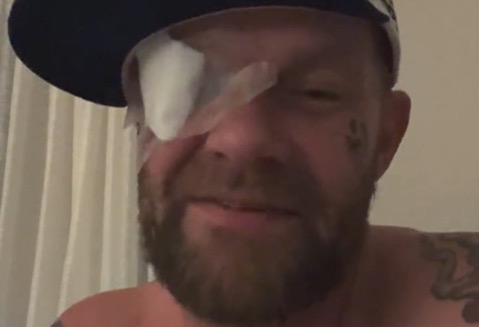
The injury occurred during an outdoor performance at Daytona International Speedway in Florida, during hot and humid weather.
Moody described the accident and its aftermath on his Instagram site: "During the set I got overheated, and I walked back and I passed out… I was grabbing towards Charlie's [the drummer's] kit. And the heat, it was exhausting. Charlie almost passed out too. I reached for a cymbal and I felt myself going under. And so I ran back. And I was okay. My guys helped me out."
"And as I'm coming back onstage, one of the lasers kicked backwards, 'cause I tripped basically over it, and it shot me in the eye. And these things are like… they basically have the power of a minor supernova; they're really bad. If you put your phone up to one of 'em, it'll actually black out your screen."
"So, anyway, I've gotta go back to Vegas [his home] and I've gotta see a real eye doctor. And hopefully it's okay. I can't see out of it right now. It's, like, have you ever stared at the sun or a lightbulb and you get that green light? It blackens it out. Imagine that times, like, a thousand. They thought my retina was separated; that's how bad it was."
"So when I go to Europe here in a couple of weeks, you all might be seeing me with a fucking patch on my eye."
(Note: He was not wearing a patch in videos of his first European tour performance on June 12 2022.)
Moody concluded: "Go ahead. Make fun. Don't care. But it is what it is. I had a blast. Like I said, I'm really sorry. I felt like I got exhausted. The weight of the humidity. 85 percent humidity in 90-degree weather, it takes a toll. And I saw a lot of you falling down. And when I went to the E.R., there were a lot of you there [being treated for heat exhaustion]."
Note: This is the second occurrence ILDA is aware of where a performer onstage was injured by laser light. If you know of any others, please contact ILDA. More information from Revolver Magazine and Blabbermouth. -
1 injured at Spanish nightclub, August 2014; possible pulsed laser
- In August 2014 a 29-year-old at a nightclub, "ZC", was exposed to a laser beam and lost sight in his left eye. He can no longer drive, and cannot do tasks that require visual acuity. He recently received a settlement of €80000 (USD $92,750).
It appears the laser used was originally for aiming in the sky, but was directed at a mirror ball which reflected the light into the audience. The laser may thus have been a pulsed laser.
There is an article about the case in original Spanish and in Google English translation, and a related article about laser show safety, also in Spanish and Google-translated English. -
1 performer injured onstage, August 2011; CW laser
- In a short YouTube video, musician Mark Hoppus from the band Blink-182 recounted a serious accident that occurred August 23, 2011 in Milwaukee. The band was using 26 watt lasers. These are shown in the video to be capable of lighting objects on fire within a few inches of the projector.
Normally the beams came from low behind the performer and then out over the audience. At worst, the beam would be on the back of the performer's body. (This is normally not permitted in a standard U.S. FDA laser show variance. It is unknown whether Blink-182 had filed with FDA for an exemption.)
Because of the Milwaukee venue, the crew had to adjust the angle of one or more of the beams to be higher above the audience.
While performing and turning backwards to look at the drummer, a higher-angled laser beam struck Hoppus directly in the eye. He initially joked about the pain, but later discovered he could not read on his computer because of a persistent ”flash” in his vision. After the symptoms failed to subside, an optometrist confirmed that he had burned his retina.
Hoppus concluded the video by noting that there is no medical treatment for the injury, leaving him with permanent damage to his eye.
Note: This is the earliest-occurring incident involving laser injury to a performer that ILDA is aware of. Thanks to Michael Kondrat for bringing this video to our attention. -
35 injured at Russian rave, July 2008; pulsed laser
- Near Moscow in July 2008, 35 persons who attended the Aquamarine Open Air Festival went to hospitals and clinics complaining of problems with their eyes.
According to a Reuters story "Attendees said heavy rains forced organizers to erect massive tents for the all-night dance party, and lasers that normally illuminate upwards into the sky were instead partially refracted into the ravers’ eyes."
Video of the incident showed that pulsed lasers were being used. Nd:YAG lasers at the time were often used for sky beams but never should have been used for audience scanning.
At the time, Reuters quoted a treating ophthalmologist as saying "They all have retinal burns, scarring is visible on them. Loss of vision in individual cases is as high as 80 percent, and regaining it is already impossible."
However, a Russian laserist who spoke with the doctor who did the examinations told ILDA the doctor said “normal sight was restored in all but four of those injured.” The four have “spots or other noticeable injuries.”
ILDA has a page at its older website, created just after the Aquamarine incident, with additional details and links.
At the time, ILDA wrote: "First and foremost, our deepest thoughts and concerns go out to those who were injured…. It appears that the lasers at this event were being used irresponsibly, haphazardly, not in accordance with international safety standards, and potentially illegally." -
19 injured at Bulgarian disco, 1999; pulsed laser
- The following is from the Rockwell Laser Industries Laser Accident Database, case #5846:
Green and yellow laser beams partially blinded up to 19 youths in a Black Sea area disco. Doctors said the damage ranged from 10% to 50% blindness but were not sure whether it would be irreversible. Another 16 youths may also have suffered retinal burns. -
1996 study finds five claimed or actual eye injury incidents
- The following is from the Scanning Audiences at Laser Shows paper listed at the bottom of this page:
A 1996 study commissioned to look for audience scanning incidents found only five reported accidents (claimed or actual eye injury).
One was due to “deliberately staring” at a disco laser beam, three were of undetermined severity, and one had an unusual, short-lived effect (the person felt “a very strong brief pain in his entire body” when the beam hit, but later reported no vision loss or subsequent ill effects).
The study commented that although the number of reports was low, it “seems within the proper order of magnitude”. This was based in part on the fact that reported laser incidents in general are relatively rare. For example, the Rockwell Laser Industries online Laser Accident Database lists an average of 16 injurious laser beam incidents per year, for all laser activity worldwide.
The study analysis also discussed whether incidents and accidents are underreported:
“Some critics assume that most or all accidents and incidents would be covered up. However, it would seem difficult to hide every report, if significant numbers of audience members are being severely injured. Disco- or concert-goers hit by lasers, who experience significant vision loss, would be likely to contact someone -- venue operators, law enforcement, medical personnel, lawyers (even outside the litigious U.S.), government officials and regulators, laser operators and/ or the media. At least some of these reports should have filtered back to those interviewed in the study.
“If we have to venture a number for the underreporting rate, 90% seems supportable. One researcher claims only 10% of all laser accidents are reported.6 This is echoed by R. James Rockwell, who feels a 90% underreporting rate seems within the correct order of magnitude.”
If 9 out of 10 accidents do not become public, this means there were roughly 50 injuries in the study’s timespan of 1964-1996. Even this is a surprisingly low number, considering that over 50 million people viewed audience scanning shows during the same period.
It is also surprisingly low compared to injury rates for other entertainment-related activities. For example, amusement park ride incidents caused roughly 72,000 injuries and 44 fatalities over a single decade, in the U.S. alone.
Source of the 1996 study: Murphy, P. Is Deliberate Audience Scanning Unsafe? "Proceedings of the 1997 International Laser Safety Conference," Vol. 3, pp. 493-502. From the paper: “We hired a professional research firm, with ten years of experience. The firm's clients include National Geographic Society, Hughes Corporation, Citicorp, University of California, [and] Sony Pictures.... The firm searched for incidents and accidents from the following sources: Electronic and library search of medical, legal, safety databases; Incident lists from Rockwell Laser Industries and Greg Makhov; CDRH data for U.S. audience scanning; [and] Original research. The original research consisted of telephone and e-mail interviews with 24 regulators, laserists, and safety professionals in Australia, Canada, England, Germany, Malaysia, Mexico, South Africa, Taiwan and the U.S.” -
2 injured at Israeli club (year and laser type unknown)
- In Israel, two teenagers in a club were injured. (They may have been intentionally staring at the beam.) As a result of the accident, Israel now requires specific laser training for show operators.
-
2 injured (by laser pointers) during Belgian festival, July 2009
- Two persons said they were injured by laser beams at the Tomorrowland electronic music dance festival, July 25-26 2009 in Boom, Belgium.
A 21-year-old woman filed a police complaint for eye damage "incurred after contact with laser light". A man also was examined with "central visibility to one eye lost"; this was "irreversible" according to the treating doctor, professor of ophthalmology Peter Stalmans of the University of Leuven as quoted in press reports.
Initial news reports on August 4 implied that the injuries were caused by lasers were from the extensive light show presented at the festival. However, authorities concluded on September 2 that the injuries were caused by misuse of laser pointers by people in the crowd.
The laser show was not found to be at fault. In fact, the mayor said that the Tomorrowland festival could return in 2010, with the same organizers and the same laser show producer.
ILDA has a page at its older website, created just after the Tomorrowland incident, with additional details and links. -
ILDA's estimates of laser show exposures
- At the top of this page, we say "As of 2025, ILDA estimates that very conservatively 180 million people have attended audience scanning laser shows, with 18 billion times that laser light has actually entered their eyes."
These figures are based on the following assumptions:- 100 nightclubs/discos/shows worldwide doing audience scanning, with 100 people nightly: 10,000 person-exposures per day
- 10,000 x 365 days equals 3,650,000 person-exposures per year
- 182,500,000 person-exposures over the past 50 years (roughly 1975 to 2025)
- The beam crosses an eye an average of 20 times per show
- During each crossing event the beam is being scanned (e.g, in a circle, line or other shape) so the laser light enters the eye
- To be conservative, say there are only 5 scans per crossing event
- 100 times laser light enters the eye per show x 182,500,000 person-exposures equals 18,250,000,000 times laser light has entered persons' eyes at laser shows, discos, etc. over 50 years.
We believe these figures to be conservative, so the actual number of persons attending audience scanning shows is probably much higher.
At a laser show, but not caused by the laser show
How ILDA estimates the number of persons exposed to laser light
The list above is as of July 2025 and has all cases known to ILDA. Obviously this does not include any cases settled privately, out-of-court, etc. If you know of any actual or suspected injuries to audience members or performers from light show lasers, please contact ILDA.
The document below goes into much more detail about reasons why there are so few injury reports from light show lasers. It also lists sources for injury reports, as of 2009. If you are at all interested in laser show injuries, please review this paper.
Scanning Audiences at Laser Shows: Theory, Practice and a Proposal A 31-page paper by Patrick Murphy and Greg Makhov, written in 2009 and updated since then. It describes audience scanning, discusses the very low number of injury reports and gives reasons why. The paper also presents ILDA's proposal to allow slightly greater laser power at venues where patrons routinely are exposed to other, more serious and prevalent risks such as hearing loss, smoking, excessive alcohol use, etc. As of 2025, ILDA is not actively supporting the so-called "10x" proposal.
ADDITIONAL INFORMATION
The document below goes into much more detail about reasons why there are so few injury reports from light show lasers. It also lists sources for injury reports, as of 2009. If you are at all interested in laser show injuries, please review this paper.
Scanning Audiences at Laser Shows: Theory, Practice and a Proposal A 31-page paper by Patrick Murphy and Greg Makhov, written in 2009 and updated since then. It describes audience scanning, discusses the very low number of injury reports and gives reasons why. The paper also presents ILDA's proposal to allow slightly greater laser power at venues where patrons routinely are exposed to other, more serious and prevalent risks such as hearing loss, smoking, excessive alcohol use, etc. As of 2025, ILDA is not actively supporting the so-called "10x" proposal.
menu